The Complete Post-Production Workflow for Film and Media
- Lily Maya

- Nov 28, 2025
- 6 min read
Updated: Mar 14
In many production conversations, post-production is described as the stage that begins once filming is finished. Technically, this is correct, but the description often hides what the phase actually represents. Post-production is not simply the final technical step in the creation of a film, a commercial project, or a media piece. It is the stage in which recorded material gradually becomes a coherent experience.
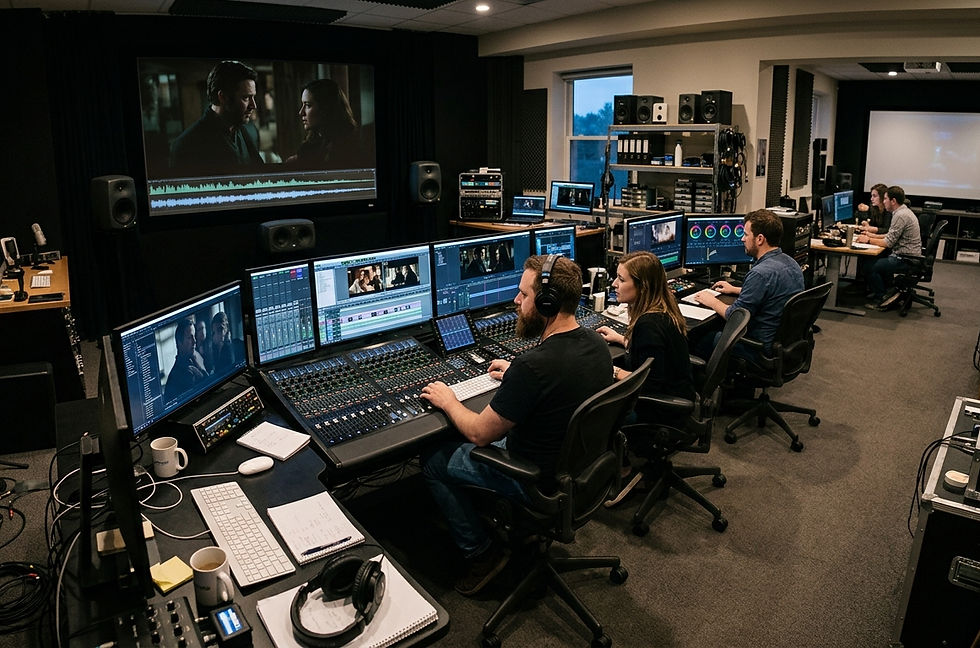
During filming, the production team captures fragments of reality: performances, locations, sounds, images, and moments that exist independently of one another. These fragments carry narrative potential, but they do not yet form a unified structure. The post-production workflow exists precisely to transform these elements into a finished work. Through editing, sound design, music production, and audio mixing, the scattered pieces of recorded material are organized into a narrative rhythm and a believable sensory environment.
What makes post-production particularly fascinating is that much of its influence remains invisible to the audience. Viewers rarely think about the editing process while watching a film, and they almost never consciously analyze the layering of ambient sound or the balance of dialogue and music. Yet these elements determine how the story is perceived. The emotional tone of a scene, the sense of realism within a space, and the continuity of the narrative all emerge through decisions made during post-production.
Understanding this transformation is essential for anyone working with film, music, or digital media. The final stage of production does not merely refine a project. It defines how the audience ultimately experiences it.
From Raw Material to Narrative Structure
Every project enters post-production as a collection of recorded assets. Footage arrives from the set, dialogue recordings exist as separate audio tracks, music may still be in development, and environmental sounds are often incomplete or missing. At this stage, the material resembles an archive rather than a finished narrative.
The first task within the film post-production process is structural organization. Editors review the available footage and begin constructing a rough sequence that reflects the intended flow of the story. This early stage of editing is sometimes called an assembly or rough cut, but its importance should not be underestimated. Even the most basic arrangement of scenes immediately influences how the narrative is interpreted.
A scene that appears early in the sequence may introduce a character differently than if it were placed later. The duration of a shot can alter the emotional tension of a moment, while the relationship between two consecutive images may suggest meaning that was not present in either shot individually. So, editing is not simply a mechanical process of selecting the best takes. It is the act of shaping narrative logic.
Within the broader video post-production workflow, this stage often involves several revisions. Directors, editors, and producers evaluate different structural possibilities until the story begins to feel coherent. Only when the visual narrative becomes stable can the remaining layers of post-production fully develop.
Editing and the Rhythm of Perception
When audiences watch a finished film or media project, they usually don’t notice the editing directly. Instead, they experience its effects through rhythm. The pace of a scene, the timing of a reaction, and the transition between moments are all determined by editorial decisions that guide the viewer’s perception.
The film editing process operates on a surprisingly subtle level. A cut that occurs a fraction of a second earlier can change the emotional emphasis of a dialogue exchange. Holding a shot slightly longer may allow the audience to observe a character’s internal state before the narrative moves forward. These choices gradually shape the psychological tempo of the story.
Professional editing resembles architecture more than assembly. Just as an architect designs how people move through a physical space, an editor designs how viewers move through time within the narrative. Images are arranged to communicate information, but also to guide emotional attention.
Within the larger post-production workflow, editing establishes the foundation upon which all other elements depend. Sound design, music, and final mixing respond to the rhythm created by the edit. If the pacing of the narrative is unstable, every other layer of post-production becomes more difficult to integrate.

Sound Design and the Construction of Atmosphere
Once the visual structure of a project stabilizes, attention turns toward the sonic environment that surrounds the images. While footage provides visual context, sound gives the world of the film its depth and presence. Without carefully constructed audio, even visually impressive scenes can feel strangely incomplete.
The film's sound design process introduces elements that may never have existed during filming. Environmental ambience, subtle background textures, and precisely timed sound effects are layered together to build a convincing acoustic space. A city street, for example, rarely feels authentic with dialogue alone. The distant resonance of traffic, the echo of footsteps, or the faint presence of wind contribute to the perception that the environment is alive.
Sound design does more than simulate realism. It also shapes emotional interpretation. A quiet scene can feel tense when the surrounding ambience gradually fades into silence. Conversely, a dense sonic environment can create a sense of scale or movement that expands the perceived space of the image.
Within the audio post-production workflow, these sonic layers interact with the visual rhythm established during editing. A sound effect placed precisely on a cut can reinforce the transition between shots, while ambient sound can smooth the continuity between locations. Through these interactions, sound design transforms visual sequences into inhabited worlds.
Music and Emotional Continuity
Music enters the process as another structural element of storytelling. In many productions, it functions as an emotional bridge that connects individual scenes into a coherent narrative experience. Whether composed as a film score or selected as part of the soundtrack, music shapes how viewers interpret the unfolding events on screen.
Within the music post-production process, composers and producers work closely with the editorial structure of the film. A musical cue may begin subtly beneath dialogue, gradually increasing its presence as the emotional intensity of the scene grows. In other moments, the absence of music may be equally important, allowing silence and environmental sound to dominate the atmosphere.
Effective film music supports the emotional trajectory of the story. The audience may not consciously register the structure of the score, yet their perception of tension, resolution, or melancholy often depends on its presence. Integrating music into the post-production workflow requires careful coordination with sound design and dialogue. Each sonic element must occupy its own space within the mix so that the emotional guidance of the music enhances the scene without overwhelming it.
Mixing and the Balance of the Sonic World
As editing, sound design, and music come together, the project enters the final stage of audio integration: mixing. The purpose of mixing is not simply to adjust volume levels but to create a balanced sonic environment in which all elements coexist clearly.
Within the audio post-production process, dialogue remains the primary reference point. Viewers must be able to understand spoken words without strain, even in scenes that contain complex sound effects or music. Around this central element, ambient textures and musical layers are arranged so that each contributes to the atmosphere without masking the others.
Mixing also involves spatial design. Sounds may be positioned across the stereo or surround field to reflect the physical environment of the scene. A passing vehicle might move across the soundstage, while background ambience fills the acoustic space behind the dialogue. These spatial decisions reinforce the illusion that the viewer is present within the world of the film.
Professional mixing transforms a collection of independent audio tracks into a coherent soundscape. When executed well, the audience experiences the sonic environment as natural and unified, and does not notice the complex technical work behind it.
Final Integration and Delivery
The final stage of the post-production workflow brings together all visual and sonic components of the project. Editing, sound design, music production, and audio mixing converge as the production prepares its final master. Color correction and grading refine the visual consistency of the image, while audio mastering ensures that the soundtrack maintains clarity across different playback systems.
At this point, the project transitions from production to distribution. The files that once represented an evolving creative process become the definitive version that audiences will encounter. Whether the final delivery is intended for cinema, streaming platforms, broadcast media, or digital distribution, the master must preserve both technical quality and narrative intention.
This moment marks the completion of the transformation that began when the first pieces of footage entered the studio. The raw material has passed through a series of interpretive stages, each contributing to the final perception of the work.
Where Material Becomes Experience
Post-production is often described as the final phase of filmmaking and media production. In reality, it is the stage where recorded material becomes a finished experience. Editing determines the rhythm through which the narrative unfolds, sound design constructs the atmosphere that surrounds the images, music shapes emotional continuity, and audio mixing integrates these elements into a single sonic world.
Together, these processes form the post-production workflow that defines how audiences ultimately perceive a film or media project. The camera may capture the raw elements of a story, but it is within post-production that those elements acquire their final structure and meaning.
When the process functions well, viewers don’t think about the technical craft behind it. They simply experience a story that feels complete, coherent, and alive.
Every project reaches a moment when raw material needs to become a finished work.
That is where our studio begins.
Comments